💰 Refer us a customer, Earn $2,000 💰

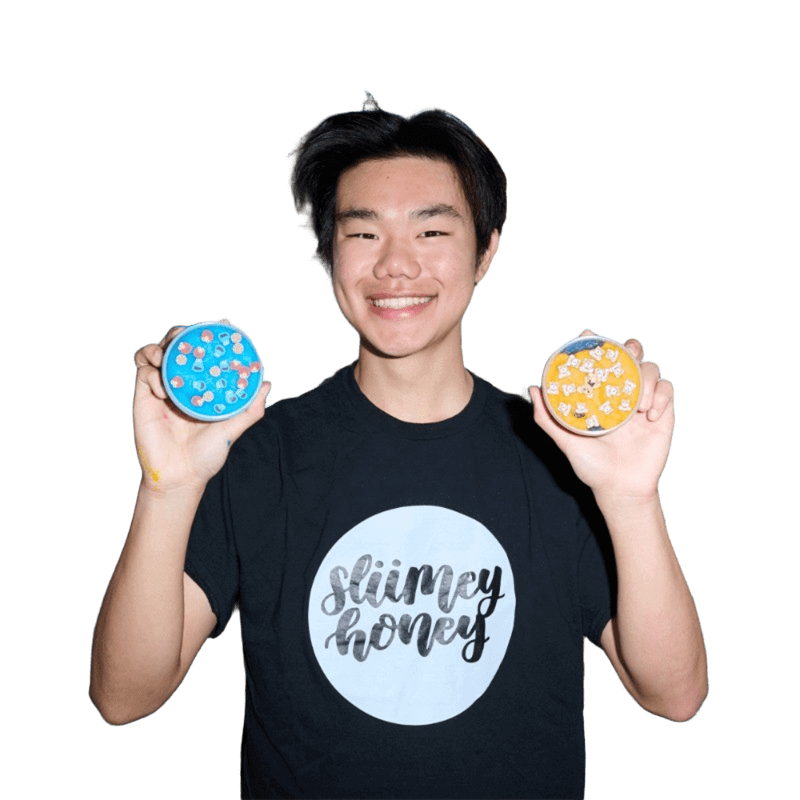

Mark Lin
Company
Sliimeyhoney
Location
Manufacturing Burbank, California
Bio
I’m Mark Lin, founder and CEO of Sliimeyhoney, a next-generation DTC brand redefining the toy and sensory wellness category. Featured on Shark Tank and powered by a loyal community of over 1 million followers, the company has generated $2.7M in revenue, shipped 200,000+ units to customers in over 100 countries, and grown into a globally recognized brand. I currently lead a team of 10 employees focused on scaling operations, expanding retail and digital channels, and innovating within the screen-free play space. My expertise lies in building consumer brands that merge creativity, community, and commerce. We create tactile products that bring nostalgia and joy to everyday life.
I’m Mark Lin, founder and CEO...
description
Sliimeyhoney is one of the largest slime companies based in Los Angeles, California. It was started in 2020 by Mark Lin as a way for people to calm down and have fun via creative and fragrant slime creations. In 2022, we took slime to mainstream audiences when we pitched our company on ABC's Shark Tank!
Sliimeyhoney is one of the largest...
Follow the guest



Actionable Takeaways
Organic Platform Distribution Can Replace Paid Acquisition in Early Stages:
Mark's first viral video (2M views) came 1-2 months after starting, generating 20,000 followers overnight and immediately selling out inventory. He posted consistently without frameworks or strategy—just authentic documentation of a 15-year-old making slime in his garage. The critical insight: for consumer brands where the founder IS the story, unpolished authenticity on native platforms (TikTok, not produced video ads) can generate initial traction without CAC. This isn't scalable past certain revenue thresholds, but it solves the cold-start problem most founders over-engineer with paid media too early.
Social Proof Opens Closed Distribution Channels Traditional PR Cannot:
After two ignored Shark Tank applications, Mark posted "Dear Shark Tank, producers cast me" on TikTok. Barbara Corcoran saw it, forwarded to producers, and he was fast-tracked into casting. The mechanic: decision-makers at traditional media outlets are active on social platforms and respond to demonstrated audience. This bypasses publicist gatekeepers entirely. For consumer marketers: identify which specific executives at target distribution channels (retailers, media, partnerships) are active on your primary platform and create call-out content that demonstrates existing demand they can activate, not aspirational pitches.
Create New Categories Through Language, Not Product Innovation:
Mark didn't invent new slime technology—he repositioned handmade slime as "gourmet slime" against "store-bought slime." The term "gourmet" signals craftsmanship and premium without the overused "premium" or "artisan." He explicitly states this language came from writing his Shark Tank pitch. The strategic value: when competing against established mass-market players, category creation through nomenclature allows premium pricing without feature-based justification. The operational question for marketers: what single word reframes your product as a distinct category that makes price comparison invalid?
Build Inventory Buffers of 3-5x Projected Demand for Media Moments:
Sliimeyhoney "prepared thousands of units" for Shark Tank airing, which sold out in 1-2 minutes. Mark then faced weeks of backorders during Christmas season while taking UCLA finals, working 15-hour manufacturing days with 14 team members. The lesson isn't "prepare more inventory"—it's that even aggressive inventory planning underestimates media-driven demand spikes by 5-10x. For consumer brands: model your absolute best-case media scenario, then triple it for inventory planning. The CAC of customers who discover you during peak attention windows but experience stockouts is infinite—they never return.
Drop Models Transform Browsing Into Buying by Training Purchase Cadence:
Sliimeyhoney releases 5 new SKUs every Saturday, maintaining 30-40 SKUs total across 1,500+ lifetime SKUs. During peak periods, Saturday restocks sold out in 30 minutes. This isn't scarcity marketing—it's operationally driven (small-batch manufacturing) but positioned as drops. The mechanic trains customers to check back weekly and conditions immediate purchase behavior ("if I don't buy now, it's gone"). For non-essential products where consideration cycles kill conversion, scheduled drops with genuine inventory constraints create urgency without feeling manufactured. Implementation requires actual constraint—fake scarcity breaks trust immediately.
Founder-Voice Content Cannot Be Delegated Until You've Solved Product-Market Fit:
At $2.7M revenue, Mark still films all content and generates all creative concepts, using interns only for editing and social media management. His reasoning: "the brand at its core needs to represent me." The insight for operators: founder-led content creates authenticity advantages in customer acquisition, but becomes a scaling constraint post-PMF. The threshold question: can your brand's conversion rate survive transitioning from founder voice to brand voice? For many consumer brands where founder story IS the positioning, the answer is no—requiring different content infrastructure than venture-scale brands assume.
Engineer Every Customer Touchpoint as Brand Differentiation, Not Just Product:
Mark describes the full experience: "Landing on the Instagram page to opening your first order...the box arrives at your door, it's so fun to open the box, to see the Slimy Honey logo inside." The slimes include scents, sprinkles, charms, glitter, clay—components that would cost more money and time to assemble at home. This justifies 2-3x pricing vs. Target alternatives through experience design, not product superiority. The framework: map every pre-purchase and post-purchase touchpoint, then design intentional moments at each. Most D2C brands over-invest in product and under-invest in packaging, unboxing, and post-purchase engagement.
Strategic AI Deployment: Automate Transactional Volume, Preserve Authentic Engagement:
Mark is testing an AI trained on his business to handle FAQ responses (shipping, discount codes) while preserving his time for meaningful customer interactions. The nuance: he explicitly sees this as solving a volume problem—"answering questions that could be solved with AI"—not replacing relationship-building. For founder-led brands, the AI deployment framework should be: automate anything that doesn't require judgment or emotion, preserve human touchpoints for conversion-critical interactions. The mistake: deploying AI for efficiency without identifying which specific interactions drive LTV.
Plan Business Model Pivots as Product Categories Mature Beyond Viral Peaks:
Slime peaked during COVID for stress relief. As demand normalized, Mark diversified to Meta ads, BOGO offers, and website revamps. He explicitly states: "I've had to become really innovative in the way that I'm selling the product." The reality for consumer marketers: viral product categories follow adoption curves—the question isn't if demand normalizes, but when. Operationally, this requires building flexibility into unit economics, channel strategy, and positioning before you're forced to pivot reactively. The planning question: what does your business model look like at 40% of peak demand?
Systematically Cultivate Founder Networks for Knowledge Arbitrage and Partnership Flow:
Mark credits founder communities for sustained motivation and explicitly mentions a founder friend building a social media AI company now creating tools for Slimy Honey. The value isn't motivation—it's knowledge arbitrage (learning what works in adjacent categories faster than competitors) and partnership deal flow (founders help founders). For consumer marketers: founder communities provide tactical ROI beyond emotional support. Identify 5-10 founders in adjacent categories (similar customer, different product) and create regular knowledge-sharing cadence. The compounding advantage is speed to market on channel innovations and partnership opportunities.
Conversation Highlights
In this episode, Andres Figueira interviews Mark Lin, Founder and CEO of Sliimeyhoney, who scaled a pandemic hobby into $2.7 million in revenue and 1 million followers without frameworks, paid acquisition, or prior business experience. Starting at 15, Mark built a manufacturing operation from his parents’ garage while maintaining UCLA academics, navigating the operational chaos of Shark Tank-driven demand spikes, and defending premium positioning in a category dominated by $5 mass-market alternatives. His approach to organic platform growth, category creation through language, and founder-led content at scale offers tactical insights for consumer brands navigating post-CAC-inflation growth strategies.
Topics Discussed:
- Weaponizing organic TikTok distribution without paid media budgets
- Converting social proof into traditional media access (Shark Tank pitch process)
- Category creation through positioning language in commoditized markets
- Operational planning for 100x demand spikes from media moments
- Scaling D2C manufacturing from founder-made to team operations
- Maintaining founder voice as primary content engine at $2.7M revenue
- Managing founder motivation cycles across five-year startup lifecycle
- Strategic AI deployment for customer service automation vs. brand preservation
- Drop model mechanics for creating recurring urgency in non-essential categories
- Business model adaptation as viral product trends mature